


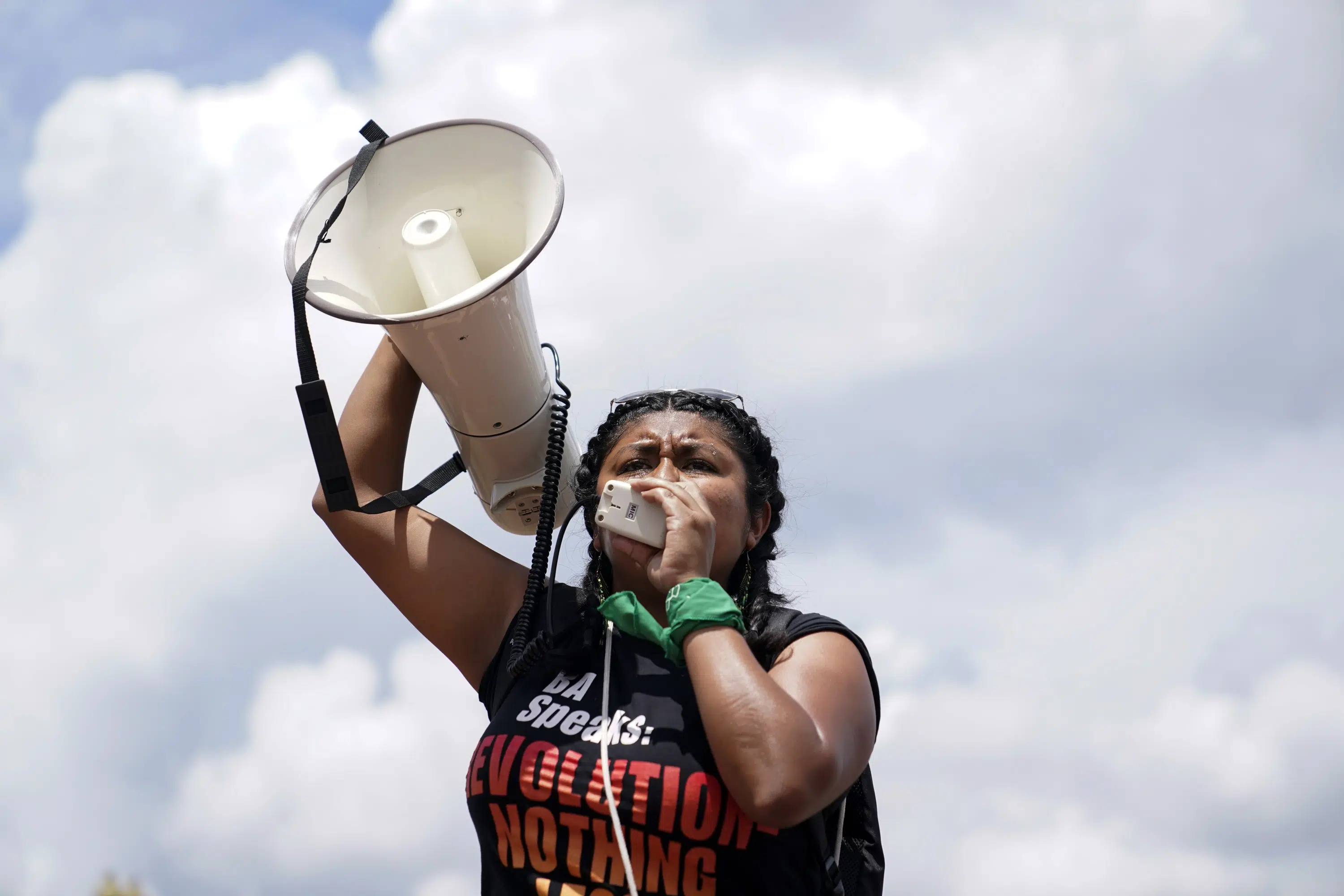
The one-year anniversary of the U.S. Supreme Court ruling in Dobbs v. Jackson Women's Health Organization, which overturned a nationwide right to abortion, was marked by both praise and protests from activists and politicians.
Rallies took place in Washington and across the country, with advocates on both sides calling attention to the landmark ruling. Supporters of abortion rights expressed anger and frustration at the interference with medical decisions between a woman and her doctor. In Chicago, dueling rallies were held with contrasting views on the issue, but no reports of clashes were made.
The Dobbs decision has made abortion a central campaign issue and deepened policy divisions between states. Republican-controlled states have implemented bans, with 14 states currently having laws in effect that block most abortions at all stages of pregnancy, with exceptions for the life and health of women and cases of rape or incest. Democrat-led states have taken steps to protect abortion access, particularly by seeking to shield doctors and others from prosecution for violating other states' abortion bans.
However, the issue remains far from settled. Judges are still assessing the constitutionality of the bans and restrictions in several states, and voters may decide on abortion-related policies in upcoming elections. Public opinion polls indicate that while there is no universal consensus, the majority opposes the most restrictive bans while also opposing unrestricted abortion access throughout pregnancy.
The Biden administration has advocated for a national law to restore abortion access, while Republicans have called for a national ban. Former Vice President Mike Pence, a GOP presidential candidate, has urged his party's candidates to support a ban after 15 weeks of pregnancy. Despite these differing positions, no federal change is imminent due to the political landscape.
The practical implications of these policies are significant. In states with the strictest bans, the number of abortions has dropped dramatically, sometimes to almost zero. Women often have to travel long distances to access abortion services, leading to exhaustion and increased use of networks that distribute abortion pills. However, due to reporting lags and gaps, the overall impact on the total number of abortions in the U.S. is unclear.
Advocates argue that there is an equity problem, with black women and lower-income women disproportionately affected by the loss of access to abortion services. The anniversary of the ruling highlights the ongoing battles, legal proceedings, and public discourse surrounding abortion rights in the United States.
https://apnews.com/article/abortion-dobbs-roe-anniversary-rally-ff6196c80112b7c9d5e6822b1807bf3e
Why did federal investigators suspect Ilhan Omar of immigration fraud during the Obama administration—and why didn’t that investigation lead to charges?
According to New York Times reporting, FBI and Homeland Security investigators examined Omar’s marriage in 2016 and found some evidence suggesting fraud. The case reportedly stalled chiefly because prosecutors concluded the potential offense fell outside the statute of limitations.
Now, renewed scrutiny raises questions about her marriage, identity, birth date, and citizenship history. In this video, I examine the records and allegations, explain citizenship through a parent, and break down the legal obstacles prosecutors could face.
We also discuss the disputed DNA claims, the marriage and tax-filing timeline, and whether an alleged conspiracy could provide a path to prosecution.
Omar denies wrongdoing. Investigative suspicions and disputed allegations are not findings of guilt. The question is what the evidence establishes—and what the ...
David Sabatini lost his lab, his job, and his reputation after Kristin Knouse accused him of sexual misconduct. Then a Boston jury awarded him $6 MILLION in his civil defamation and interference case and rejected her counterclaims.
What happened when the text messages and deposition testimony faced scrutiny?
Nate the Lawyer breaks down the allegations, the NYU protests, the messages described as “covert operation dethrone,” and the $6 million verdict. We also examine Whitehead’s defense of its investigation, the workplace-policy issues, and the parallels raised in this video with the Cornell 7 controversy.
Is $6 million enough after someone loses their career and reputation? And what responsibility do institutions have to examine the evidence before acting? Let me know in the comments.
TIMESTAMPS
00:00 Sexual misconduct allegations—and a $6 million verdict
02:00 Back to the Sabatini case
02:50 Lost jobs, public backlash, and NYU protests
03:40 Kristin Knouse’s allegations and the ...
A federal judge blocked Mississippi’s DEI ban. Then came the discovery: his order contained incorrect quotes, misidentified parties, and a case that didn’t even exist.
Judge Henry Wingate acknowledged that his law clerk used artificial intelligence to help draft the order. But the Fifth Circuit Court of Appeals had plenty to say about what happened next—including calling the district court proceedings “a botch job.”
In this video, we break down Mississippi’s DEI law, the challenge to it, the fake citations, and the appeals court’s blistering criticism. Then we tackle the bigger question: What does this controversy actually tell us about DEI, qualifications, and accountability?
Wingate was a Reagan appointee, a Yale Law School graduate, and an experienced federal judge. So how did an order with these errors make it onto the docket?
You are the jury. Let me know what you think in the comments.
TIMESTAMPS
00:00 - Intro: Federal Judge Caught Using AI in DEI Ruling
00:48 - ...
And We’re Back!
And we're back, y'all. I appreciate every single one of you supporting the channel right here behind the paywall. You get the unvarnished analysis, the procedural realities, and the raw legal breakdowns before the mainstream algorithms try to throttle the reach, shadowban the facts, or bury the story.
The Inside Story of an 11-to-1 Jury Room
Today, we are diving into the exclusive sit-down interview with three jurors from the Lindsay Clancy trial who finally broke their silence—and what went down in that deliberation room is crazy, y'all!
Now, the public saw a hung jury mistrial. But when these jurors walked through what actually happened during deliberations, it wasn't some evenly divided debate over the facts.
It was 11 to 1 for Not Guilty by Reason of Insanity.
Eleven jurors were ready to sign the forms committing her to a state psychiatric facility. And the lone holdout? The other jurors revealed that he actually admitted during deliberations that he had reasonable doubt, but refused to vote not ...

And We’re Back!
And we're back, y'all. I appreciate every single one of you supporting the channel right here behind the paywall. You get the raw receipts, the unredacted files, and the unfiltered legal analysis before the algorithms try to throttle the reach, shadowban the facts, or bury the story.
The Narrative Completely Collapse
Today, we are diving right back into the Karmelo Anthony murder case out of Texas, and the newly leaked text messages published in full context by the Daily Mail are completely crazy, y'all!
Quick recap: Karmelo Anthony was convicted of murder and sentenced to 35 years in prison for fatally stabbing 17-year-old Austin Metcalf in the chest at a track meet. The internet immediately turned this into a massive, racially charged civil rights crusade. Activists rallied, social media commentators took up arms, and an online GiveSendGo fundraiser hauled in over $630,000 for his defense before it was pulled from public view.
Now, his legal team and family have launched a brand-new $250,000 legal defense ...

And We’re Back!
And we're back, y'all. I appreciate every single one of you supporting the channel right here behind the paywall. You get the raw receipts, the procedural breakdowns, and the unfiltered legal analysis before the algorithms try to throttle the reach, shadowban the facts, or bury the story.
The Mirror-Image Case Nobody Talked About
Today, we are looking at a case out of Linn County, Iowa, that is an absolute mirror image of the Lindsay Clancy tragedy—and the legal outcome on this one is crazy, y'all!
For the past year, social media and the legal commentary circuits have been arguing one specific talking point: "If a MAN had strangled his children and claimed psychosis or mental breakdown the way Lindsay Clancy did, he would be convicted of First-Degree Murder and sent to prison for life in two seconds flat."
Well, a man did do it. Almost a year after Lindsay Clancy strangled her three children in Massachusetts, 45-year-old insurance executive Matthew Schlier strangled his 5-year-old son, Jack, to death in Marion, ...